- WHAT IS SERVICE
MANAGEMENT?
Service management
is a set of specialised organisational capabilities for providing value to
customers in the form of services.
These ‘specialised
organisational capabilities’ include the processes, activities,functions and
roles that a service provider uses in delivering services to their customers,
as well as the ability to establish suitable organisation structures, manage
knowledge, and understand how to facilitate outcomes that create value.
- ‘BEST PRACTICE’
VERSUS ‘GOOD PRACTICE’
The term ‘best
practice’ generally refers to the ‘best possible way of doing something’.
The idea behind best
practice is that one creates a specification for what is accepted by a wide
community as being the best approach for any given situation. Then, one can
compare actual job performance against these best practices and determine
whether the job performance was lacking in quality somehow. Alternatively, the
specification for best practices may need updating to include lessons learned
from the job performance being graded.
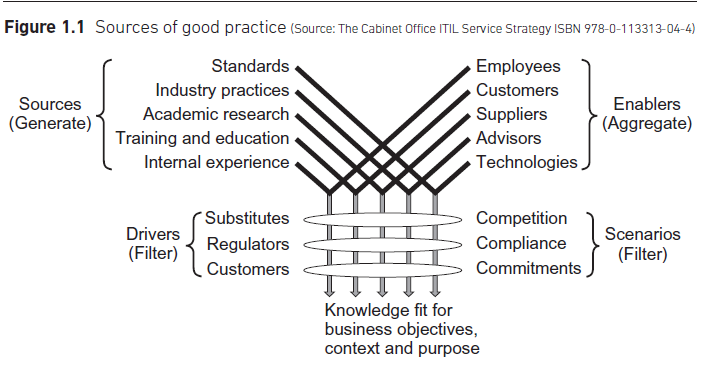
Enterprises should
not be trying to ‘implement’ any specific best practice, but adapting and
adopting it to suit their specific requirements. In doing this, they may also
draw upon other sources of good practice, such as public standards and
frameworks, or the proprietary knowledge of individuals and other enterprises
as illustrated in Figure 1.1.
Enterprises
deploying solutions based on good and best practice should, in theory, have an
optimal and unique solution. Their solution may include ideas that are
gradually adopted by other enterprises and, having been widely accepted,
eventually become recognised inputs to good and best practice.
ITIL is not a
standard in the formal sense but a framework which is a source of good practice
in service management. The standard for IT service management (ITSM) is ISO/IEC
20000, which is aligned with, but not dependent on, ITIL.
As a formal
standard, ISO/IEC 20000 defines a set of requirements against which an
organisation can be independently audited and, if they satisfy those requirements,
can be certificated to that effect. The requirements focus on what must be
achieved rather than how that is done. ITIL provides guidance about how
different aspects of the solution can be developed.
The ITIL Library has the
following components:
- ITIL Core: Publications describing generic
best practice that is applicable to all types of organisation that provide
services to a business.
- ITIL Complementary Guidance: A set of publications with
guidance specific to industry sectors, organisation types, operating models and
technology architectures.
The objective of
the ITIL service management framework is to provide guidance applicable to all
types of organisations that provide IT services to businesses, irrespective of
their size, complexity, or whether they are commercial service providers or
internal divisions of a business.
The service
lifecycle is an approach to IT service management that emphasises the importance
of coordination and control across the various functions, processes and systems
necessary to manage the full lifecycle of IT services. The service management
lifecycle approach considers the strategy, design, transition, operation and
continual improvement of IT services.
Complementary
material may take the form of books or web-based material and may be sourced
from the wider industry, rather than from The Cabinet Office/The Stationery
Office (TSO). Examples of such material are glossary of terms, process models,
process templates, role descriptions, case studies, targeted overviews and
study aids for passing examinations. These will typically be officially
commissioned and published by TSO.
Apart from the ISO/IEC
20000 standard, ITIL is also complementary to many other standards, frameworks
and approaches. No one of these items will provide everything that an
enterprise will wish to use in developing and managing their business. The
secret is to draw on them for their insight and guidance as appropriate.
- THE ITIL SERVICE
MANAGEMENT MODEL
The design
definition is passed to the service transition stage, where the service is
built, evaluated, tested and validated, and transitioned into the live
environment, where it enters the live service operation stage. The transition
phase is also responsible for supporting the service in its early life and the
phasing out of any services that are no longer required. Service operation
focuses on providing effective and efficient operational services to deliver
the required business outcomes and value to the customer. This is where any
value is actually delivered and measured.
Value
From the earlier definition of a
service, it is clear that the primary focus is on delivering value to the
service consumer. Value is created through providing the right service under
the right conditions.
Service assets
Service providers create value
through using their assets in the form of resources and capabilities.
Service model
A service model describes how a
service provider creates value for a given portfolio of customer contracts by
connecting the demand for service from the assets of its customers with the
service provider’s service assets.
Functions, processes and roles
The terms function, process and role
are often confused. This is not surprising since they are so intertwined. In
addition, the way the words are used in ITIL is precise, and may be confused
with the way these words are used in a more general context.
Process characteristics
A process transforms a prescribed
set of data, information and knowledge into a desired outcome, using feedback
as a learning mechanism for process improvement.
Role
A set of responsibilities,
activities and authorities granted to a person or team.
Daftar Pustaka : IT_Service_Management_2nd_Edition.pdf